Yes to new nuclear power plants
What the vote is about
On June 19, 2026, the Swiss Parliament lifted the ban on building new nuclear power plants that had been in force since 2017, clearing the way for replacement reactors at existing sites. A broad alliance of anti-nuclear organisations responded with a referendum against this “nuclear law.” Should it gather the signatures it needs, Swiss voters will return to the ballot box on the future of nuclear energy, probably in early 2027.
Whether Switzerland continues to rely on nuclear energy is not a technical detail of electricity production. The consequences of this vote reach well beyond energy policy in the narrow sense and will shape the country and its place in Europe for decades. This report therefore sets out the central arguments of the opposition campaign and examines them closely. What holds up, what misleads, what is incomplete or simply wrong? We want to put factual ground under a debate that too often runs on overstatement instead of on figures that hold.
The question on the ballot touches three areas of fundamental importance.
The first is the economy and prosperity. Reliable, affordable electricity is a precondition if Switzerland is to remain an attractive location for energy-intensive industry, data centres and emerging technologies. When companies decide where to invest, they weigh how dependably and how cheaply they can be supplied with energy.
The second is sovereignty. A country that covers a growing share of its winter electricity demand from abroad becomes dependent on political and economic developments next door: on its neighbours’ generating fleet, their price levels, their energy policy choices. Should Switzerland also remain dependent on fossil fuels, natural gas above all, geopolitical dependencies come on top that reach far beyond Europe’s borders. In a period of mounting international conflict, dependencies of that kind can turn expensive. More generally, room for manoeuvre in foreign policy shrinks in line with control over the country’s own energy supply.
The third is climate targets, no less weighty than the other two. Switzerland has committed to net zero greenhouse gas emissions by 2050. Nuclear energy contributes to that goal, contrary to what the public debate often assumes, because it supplies firm, practically CO₂-free baseload power regardless of weather or season. As heating and transport shift to electricity, that reliability is precisely what the system needs.
The drought summer of 2026 exposed a problem that has drawn little attention so far. After the driest spring since records began and an exceptional heatwave, water levels in many reservoirs and rivers fell to historic lows, and heavy production losses followed. Hydropower, so often presented as the Swiss alternative to nuclear energy, is itself facing growing risks from climate change to availability and to safety alike. Media coverage that summer concentrated on individual nuclear plants forced to throttle output for lack of cooling towers or cooling ponds, which gave a distorted picture of where the real supply risks lie. A net-zero strategy resting on a weatherdependent resource whose reliability is expected to deteriorate carries more risk than one resting on a weather-independent technology such as nuclear power.
These three dimensions form the framework for this joint report by WePlanet DACH and the Anthropocene Institute, which examines seven claims made by the opposing campaign in the chapters that follow.
We then present an analysis by the Anthropocene Institute. In 2021 and 2025, two Swiss nuclear power plants were offline for several months for scheduled maintenance (Leibstadt in 2021, Gösgen in 2025). These episodes allow us to examine what that loss of capacity meant at the time, and to ask what it tells us about a possible future Swiss electricity supply without nuclear power.
The opposing campaign's claims – and what should be said about them
In their campaign, supporters of keeping the construction ban in place make a series of claims whose shared message is: Switzerland does not need new nuclear power plants. Yet, the nuclear opponents’ arguments share another trait: as we will show below, they are misleading, incomplete or simply wrong.
“A Parliamentary Decision Against the Will of the People”
The opposing campaign claims“With the Nuclear Energy Act, Parliament and the Federal Council are opening the door to new nuclear power plants in Switzerland against the will of the voting population. [...] The electorate has clearly chosen a renewable future three times – in 2017 with the Yes to the Energy Strategy, in 2023 in the vote on the Climate Protection Act, and in 2024 with a clear approval of the Electricity Act.” (Alliance “Nein zu neuen AKW,” press release of June 30, 2026)1
This portrayal is misleading: to begin with, only the 2017 vote directly concerned nuclear power. That was when the ban on new nuclear power plants was introduced, as Art. 12a of the Nuclear Energy Act: “General licenses for the construction of nuclear power plants may not be granted.”2 The 2023 Climate Protection Act set net-zero-2050 targets and an incentive-program fund, without mentioning nuclear power at all or ruling it out as a pathway. The 2024 Electricity Act accelerates the expansion of renewables and grid infrastructure but leaves the existing construction ban untouched, without addressing it. The opposing side thus lumps together three very different pieces of legislation as “three clear votes for a renewable future,” even though only one of them actually put the nuclear power question to a vote – the one the longest ago.
Moreover, the claim ignores the shift in Swiss public opinion. No decision is made for all time – only until circumstances and majorities change. And that Swiss voters’ view of nuclear energy has shifted is clearly shown by recent polling:
According to a survey by Leewas, commissioned by “20 Minuten” and Tamedia in September 2025, 56 percent of Swiss people now support lifting the ban on new nuclear power plants, with only 42 percent opposed.3 Particularly notable: for the first time since the GFS Bern survey series began in 2022, half of respondents now prefer building a single new nuclear power plant4 over adding several new renewable-energy installations. Beyond that, the generally more positive attitude toward nuclear energy is also reflected in views on existing nuclear plants: a clear 79 percent of eligible voters now support their continued operation, as long as the reactors are considered safe, according to the study “Security of Supply 2026,” conducted by GFS Bern on behalf of the Swiss Electricity Association (VSE) (as of April 2026).5
This shift in opinion is likely closely tied to the energy crisis since the start of the war in Ukraine and the intensifying climate crisis. Both have brought questions of secure, affordable and clean energy supply back to the centre of attention. It is not Parliament acting against the will of the population – rather, the opponents are lagging the shift in public opinion. And that is precisely why the question is now, logically, returning to the ballot box: with the vote in early 2027, the population can express its position directly at the polls. That is not a circumvention of democracy – it is its core.
Sources (5)
- [1] Alliance “Nein zu neuen AKW,” press release of June 30, 2026: https://www.neue-akwnein.ch/aktuelles/buendnis-lanciert-referendum-gegen-das-atom-gesetz ↩
- [2] Nuclear Energy Act (KEG) of March 21, 2003, Art. 12a, SR 732.1: https://www.fedlex.admin.ch/eli/cc/2004/723/de ↩
- [3] 20 Minuten / Tamedia (survey: Leewas), September 2025: https://www.20min.ch/story/neubauverbotgeht-es-noch-ohne-akw-frage-spaltet-das-volk-und-die-politik-103430471 ↩
- [4] cash.ch, “Nuclear energy gains significant support in survey”: https://www.cash.ch/news/topnews/kernenergie-gewinnt-in-umfrage-deutlich-an-ruckhalt-943219 ↩
- [5] GFS Bern, “Security of Supply 2026” (commissioned by VSE), as of April 2026: https://www.gfsbern.ch/de/news/versorgungssicherheit-2026/ ↩
“Nuclear Power makes Switzerland Dependent on Foreign Countries”
The opposing campaign claims“Nuclear power may produce electricity, but it makes us directly and heavily dependent on major powers such as Russia, China, France and the United States.” (Alliance “Nein zu neuen AKW”, “New reactors make us dependent on other countries”)1
The claim names four countries in a single breath – and in doing so it says both too much and too little. Too much, because dependence on France and the United States would, by the same standard, count against solar modules from China or gas from Norway; by that criterion no technology would survive. Too little, because it conflates uranium mining with the downstream production of fuel rods – above all the enrichment of fissile uranium, which is what the issue actually turns on.
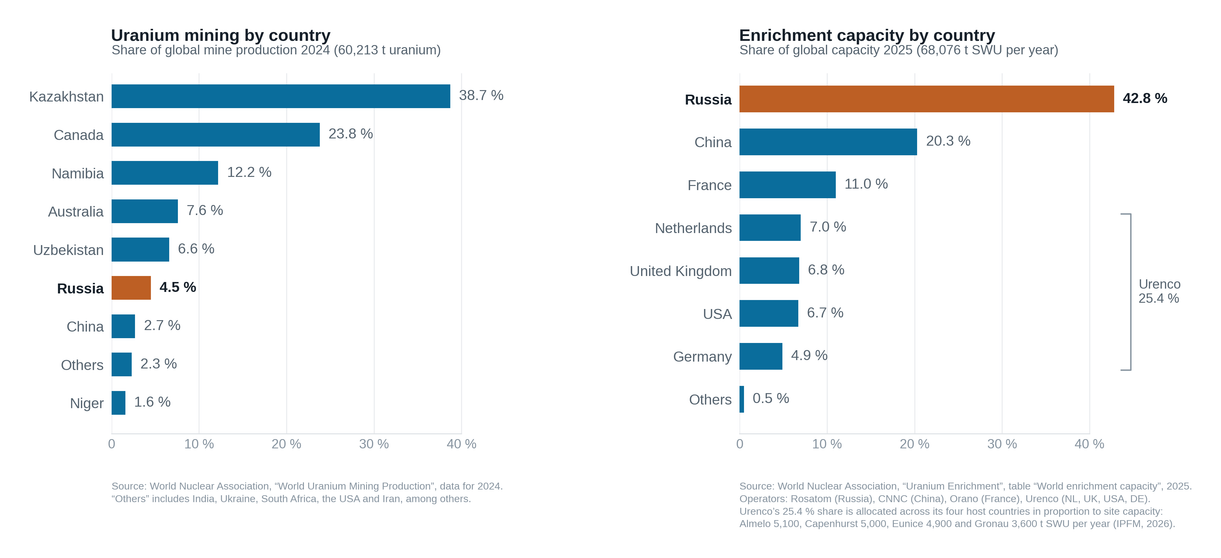
The raw material itself poses no problem. Russia, so often invoked, mines only a small fraction of the world's uranium. By far the largest producer is Kazakhstan, followed by Canada, Namibia, Australia and Uzbekistan – only then comes Russia, in sixth place.2 The sheer range of suppliers rules out any dependence here. The bottleneck lies in downstream processing: because Western companies outsourced these steps for cost reasons in the past, the Russian state corporation Rosatom currently controls around a third of global conversion capacity and almost half of global enrichment capacity. That mistake was recognised at the latest after Russia's attack on Ukraine. Since then, Western suppliers such as Urenco and Orano have been expanding their own capacity.3 Orano is extending its Georges Besse II plant in France with support from the European Investment Bank, and Urenco has appreciably increased its enrichment capacity.4
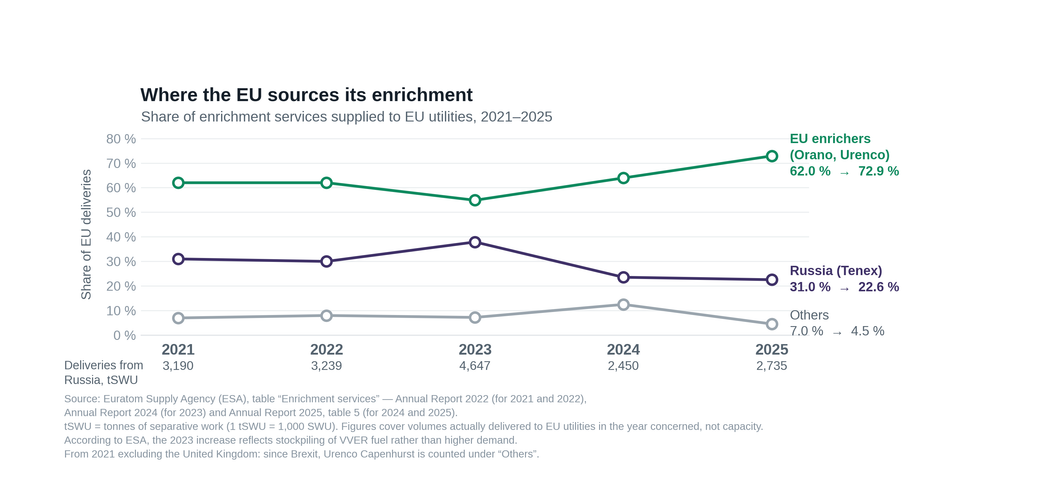
Compared with earlier years, the situation has changed noticeably. Shortly after the war began, Axpo decided to sign no new contracts with Russian suppliers and to “forgo Russian suppliers throughout the entire supply chain.” In February 2025 the company signed new fuel contracts with producers in Canada and Kazakhstan; according to Axpo, thanks to existing reserves, fuel supply for Leibstadt and Beznau has not depended on Russian sources since 2022.5 Greenpeace disputes this account and points to indirect deliveries via intermediaries6, yet the trend is unambiguous: the dependence was real, it is now declining, but it has not been eliminated entirely – typical of a transitional phase of the kind other European countries are also going through.
For the question actually on the ballot, the current situation is in any case not decisive: new build concerns plants that would come online in the 2040s at the earliest. Anyone who wants a secure, broadly based fuel supply should therefore not forgo new nuclear plants, but negotiate Western supply contracts and flexibility from the outset – as Axpo is now demonstrating for the existing plants.
Sources (6)
- [1] Alliance “Nein zu neuen AKW,” “New reactors make us dependent on foreign countries”: https://www.neue-akw-nein.ch/argumente/abhaengigkeit ↩
- [2] World Nuclear Association, “World Uranium Mining Production” (2024 production figures): https://worldnuclear.org/information-library/nuclear-fuel-cycle/mining-of-uranium/world-uranium-mining-production ↩
- [3] Avenir Suisse, “The Heart of the Matter (Fuel)?”: https://www.avenir-suisse.ch/des-pudels-kernbrennstoffe/ ↩
- [4] Nuklearforum Schweiz, “France expands uranium enrichment plant with EIB support”: https://www.nuklearforum.ch/de/news/frankreich-erweitert-urananreicherungsanlage-mit-eib-unterstuetzung ↩
- [5] Axpo, press release “Axpo signs new fuel contracts for nuclear power plants,” February 17, 2025: https://www.axpo.com/ch/de/newsroom/medienmitteilungen/2025/axpo-signs-new-fuel-contracts-fornuclear-power-plants-.html ↩
- [6] Greenpeace Switzerland, “Uranium for Axpo’s nuclear power plants: Russia’s long shadow,” May 2026: https://www.greenpeace.ch/static/planet4-switzerland-stateless/2026/05/20260528-Uran-fuer-die- Atomkraftwerke-der-Axpo_-Russlands-langer-Schatten-Volltext.pdf ↩
“The ‘Swiss Way’ with Solar, Wind and Hydropower Is Already a Success”
The opposing campaign claims“This path is a success: Switzerland can cover its electricity demand with domestic energy from solar, wind, and hydropower.” (Alliance “Nein zu neuen AKW,” press release of June 19, 2026)1
That is true neither today nor in the electricity industry's own scenarios for the future. Even now, Switzerland can only meet its winter demand through imports – in the first week of November 2025 alone it imported 194 GWh, after the balance tipped at the end of October following an export-heavy summer.2 Nor does full self-sufficiency appear in the picture for 2050. According to the January 2025 update of the study “Energiezukunft 2050” by the Swiss Electricity Association (VSE), even with full implementation of the Electricity Act – that is, an expansion of renewables to 45 TWh by 2050 – net imports in the winter half-year remain necessary: the Act caps them at a maximum of 5 TWh, and the model works with that ceiling. Alongside them, “complementary generation” from gas-fired plants is required. These are to be run “ideally on climate-neutral gases”; the modelling nonetheless assumes fossil natural gas with carbon capture, because hydrogen and biogenic gases do not enter the mix “on account of their high costs”. And should the expansion of renewables fail to materialise, the association states that the need for complementary generation in the winter half-year doubles, and that it “may then, in the case of gas, no longer be possible domestically in a fully climate-neutral way. All the harder and more expensive, then, to achieve climate neutrality.”3
Without nuclear power, that dependence is likely to grow further. Shortening the operating life of the existing reactors from 60 to 50 years alone would push winter imports from 2 to 4 TWh in 2030, and from 5 to 9 TWh in 2040, according to the ETH/PSI white paper “Versorgungssicherheit.”4 None of which should surprise anyone: if nuclear capacity disappears without something else stepping in one-for-one, dependency on imports increases. It is also doubtful whether the aggressive expansion of renewables assumed by scenarios like the one above can actually be achieved in practice: wind power expansion has made virtually no progress for years – Switzerland has just 50 wind turbines, supplying less than 0.5 percent of the electricity mix, while permitting procedures take over 20 years and project opponents “exhaust every legal avenue to delay projects,” according to Suisse-Eole spokesperson Olivier Waldvogel.5 Resistance is also growing for high-alpine solar power: under the “Solarexpress,” introduced in 2022 as an urgent federal law that subsidises large alpine solar installations with up to 60 percent of investment costs and is meant to speed up approvals, around 30 large installations are currently still in planning, but a similarly large number have already been rejected or withdrawn. In the canton of Valais, where the program was politically initiated, not a single plant was standing as of the end of 2025.6 The “Swiss way” is not just a question of potential, but also of political and legal reality.
The gap between clean production and demand shows in the carbon footprint – regardless of whether one measures Switzerland’s own production or actual consumption. According to the “Grid Review 2025” report by Electricity Maps, Switzerland’s production-based emissions intensity in 2025 was just under 29 grams of CO₂ per kilowatt-hour, but on a consumption basis – that is, including the actual origin of imports – it was nearly double that, at 50 grams. The seasonal weakness is even more pronounced: in the summer of 2025, consumption-based intensity ranged from 28.8 to 38.4 grams of CO₂ per kilowatt-hour, while in the winter it ranged from 39.3 to 90.8 grams – meaning the winter peak was more than three times as high as the summer low.7 The VSE’s forecast through 2050 does project further improvement, but explicitly only under the assumption that gas-fired power plants “will be necessary as supplementary production,” not because solar, wind and hydropower would be enough on their own.8
The story of a successful Swiss path built on sun, wind and water therefore fails already against the present. It describes not what is, but what is hoped for. Whether the path at least works out by 2050 is a separate question, taken up in Claim 7.
Sources (8)
- [1] Alliance “Nein zu neuen AKW,” press release of June 19, 2026: https://www.neue-akwnein.ch/aktuelles/buendnis-nein-zu-neuen-akw-bereitet-referendum-gegen-atom-gesetz-vor ↩
- [2] 20 Minuten, “This is why Switzerland’s electricity supply is at risk,” March 29, 2026: https://www.20min.ch/story/atomdebatte-darum-ist-die-versorgung-der-schweiz-mit-stromgefaehrdet-103372965 ↩
- [3] VSE, “Resiliente Stromversorgung: Gesamtsystem fit machen für neue Realitäten – Update EZ2050, Erläuterungsbericht”, 9 January 2025. Expansion target of 45 TWh and the 5 TWh cap on winter imports under the Electricity Act: pp. 8 f.; the “gas-fired plants” variant and the cost rationale for natural gas with carbon capture: p. 18; the “NIMBY” scenario with a doubled need for complementary generation: p. 31. https://www.strom.ch/de/media/15193/download (Quotations translated from the German original.) ↩
- [4] ETH Zurich / PSI, white paper “Security of Supply” (Energy Science Center, June 2026), Figure 8: https://ethz.ch/content/dam/ethz/special-interest/mavt/energy-science-centerdam/research/publications/ETH_Zurich_ESC_Whitepaper_Versorgungssicherheit.pdf ↩
- [5] Windkraft-Journal, “Development of wind energy in Switzerland,” February 13, 2026 (quoting Olivier Waldvogel, Suisse-Eole): https://www.windkraft-journal.de/2026/02/13/entwicklung-der-windenergie-inder-schweiz/221485 ↩
- [6] SWI swissinfo.ch, “Switzerland’s Alpine solar push: the first findings,” January 29, 2026: https://www.swissinfo.ch/ger/klimaanpassung/schweizer-solar-offensive-in-den-alpen-das-sind-dieersten-erkenntnisse/90760813 ↩
- [7] Electricity Maps, “Electricity Grid Review 2025: Switzerland”: https://www.electricitymaps.com/grid-inreview-2025/switzerland ↩
- [8] VSE, “CO₂ content of the Swiss electricity mix and forecast to 2050”: https://www.strom.ch/de/nachrichten/vse-publiziert-aktuellen-co2-gehalt-des-schweizer-strommixesund-prognose-bis-2050 ↩
“Nuclear Waste Is an Unsolved Problem”
The opposing campaign claims“Nuclear waste [is a] toxic legacy without a solution. A solution for disposal has been sought for decades – with no success to report so far.” (Alliance “Nein zu neuen AKW,” “Key Arguments,” “Nuclear Waste”)1
That is no longer accurate: Switzerland has now resolved the site-selection question. After more than 50 years of research and a multi-stage, scientifically supervised selection process, the National Cooperative for the Disposal of Radioactive Waste (Nagra) submitted the general licence application for a deep geological repository in the Nördlich Lägern area (municipality of Stadel, canton of Zurich) in 2024. The rock there consists predominantly of Opalinus Clay – a very dense, water-impermeable claystone in which the waste will be safely contained for up to a million years. Preparatory work is scheduled to begin in 2034, actual construction is planned to start in 2045, and estimated costs are around CHF 12 billion.2 For the waste from existing nuclear power plants, at least, the “unsolved problem” is thus technically and geographically solved – what remains is a long but predictable approval and construction process.
Nuclear opponents occasionally claim that the planned repository would not be sufficient for future waste from new plants. That is a half-truth: it is correct that Nagra’s current general licence application is explicitly only for the waste from existing facilities.3 But there is no geological limit behind this – only the scope of the application currently underway. New builds were previously banned and therefore simply were not part of the planning. Geologically, there would still be room at the site, according to Nagra.4 For new plants, a separate or expanded approval procedure would therefore be needed, not necessarily an entirely new repository site. That’s an additional administrative and regulatory step, not an unsolved technical problem.
On top of that, while nuclear waste is a serious hazardous substance requiring careful, long-term containment far outside the biosphere, its danger is often overstated in public debate – this is especially true compared with other long-term hazardous waste:
First, the toxicity of nuclear waste does not remain constant but measurably decreases over time. At the time of disposal (about 20 years after removal from the reactor), the radiotoxicity – the toxicity of a substance if ingested, compared with the acute toxic dose of known poisons – of highly radioactive waste is roughly comparable to the acute toxicity of strong chemical poisons. However, after around 20,000 years it falls below the acute toxicity of natural uranium (LD50 approx. 5 grams), and after around 50,000 years its toxicity roughly matches that of aspirin (LD50 approx. 20 grams).5 By comparison: other toxic substances permanently stored underground, such as mercury, cyanides or arsenic compounds – including the more than 3.2 million tonnes of hazardous waste at Germany’s Herfa-Neurode underground repository – remain chemically toxic forever; their danger never decreases.
Second, highly radioactive waste is stored exclusively in a solid, ceramic-like form, which makes it considerably harder to disperse compared with liquid or gaseous pollutants. A worst-case calculation by Nagra for the planned Nördlich Lägern repository shows how robust this concept is: even if the steel storage canisters were missing or had already completely corroded through after a short time, the radiation dose for the most affected individual would remain below the protection criterion of 0.1 millisieverts per year – barely a fiftieth of the natural background radiation in Switzerland. In the most likely scenario, it is even a factor of 1,000 below that.7 Comparable worst-case calculations for Finland’s Onkalo deep repository arrived at similarly low dose values under similarly extreme assumptions. Both properties – decreasing rather than constant hazard, and a solid rather than liquid or gaseous form – combined with a safety concept that accounts for even a total failure of the canisters, mean that nuclear waste is technically manageable.
Sources (7)
- [1] Alliance “Nein zu neuen AKW,” “Key Arguments,” “Nuclear waste: toxic legacy without a solution”: https://www.neue-akw-nein.ch/argumente/atommuell ↩
- [2] EKZ Blue, “Nagra – a safe solution to the pressing nuclear waste problem” (2025): https://www.ekz.ch/de/blue/wissen/2025/nagra.html ↩
- [3] SRF, “Nuclear repository in Stadel ZH: Nagra CEO – there is no Plan B,” November 19, 2024: https://www.srf.ch/news/schweiz/atom-endlager-in-stadel-zh-nagra-chef-es-gibt-keinen-plan-b ↩
- [4] Nau.ch, “The repository site would have enough room for waste from further nuclear plants”: https://www.nau.ch/news/wirtschaft/am-endlager-standort-hatte-es-genug-platz-fur-abfall-weitererakws-67147272 ↩
- [5] Rainer Moormann, “Nuclear Waste – An Unsolved, Unsolvable Problem?” (2021), citing R. Kathren, “Acute Chemical Toxicity of Uranium” (NRC, 2008) ↩
- [6] Wikipedia, “Herfa-Neurode underground repository”: https://de.wikipedia.org/wiki/Untertagedeponie_Herfa-Neurode ↩
- [7] Nagra, “Nagra plans for the worst case itself — worst-case scenarios”: https://nagra.ch/die-nagra-rechnet-selbst-mit-dem-schlimmsten-worst-case-szenarien/ ↩
“Nuclear Energy Is Too Expensive”
The opposing campaign claims“A single build swallows around 25 billion [francs].” Nuclear power is “a money pit with additional negative effects.” (Alliance “Nein zu neuen AKW,” “Key Arguments,” “Costs”) 1
The cost question is fair but often presented one-sidedly. A study published in July 2026 by BAK Economics, commissioned by economiesuisse, estimates the investment cost for a new nuclear power plant (an EPR-1600 reactor, commissioning in 2050) at around CHF 17.25 billion – significantly below the CHF 25 billion cited by the opponents. The difference stems mainly from the basis of calculation: BAK Economics bases its figures on the construction costs of Finland’s Olkiluoto 3 reactor rather than the French Flamanville 3 project, whose costs were, according to the study’s authors, heavily shaped by one-off special factors.2 Over the entire 60-year operating life, the study forecasts an annual economic value-added effect of CHF 1.6 billion and around 2,900 jobs; from the start of operations in 2050, wholesale electricity prices are also expected to fall.2
The study does assume that market revenues would cover only around 55 percent of the levelised cost of electricity (64 versus 115.5 CHF per megawatt-hour) – the difference of around CHF 625 million per year would need to be offset by government support, not as a one-off payment but continuously over the entire 60-year operating period. That sounds enormous but is ultimately no higher than the support given to other energy sources – as the example of alpine solar installations shows. Based on the average investment cost of CHF 4,048 per kWp of installed capacity for Solarexpress projects3 and the maximum one-off payment of 60 percent of investment costs4, this works out to support of around CHF 2,429 per kWp of installed capacity. Alpine solar installations can achieve higher output than installations on the Swiss plateau – 1,400 kWh per kWp is entirely realistic. Yet even at such high output, and assuming a plausible operating life of 30 years, the support amounts to around CHF 58 per megawatt-hour – more than the CHF 51.50 (115.5 minus 64) that new nuclear power plants require according to the study's authors. Factor in the usual module degradation of around 0.5 percent per year, and the average yield over 30 years is some 7 percent lower, pushing the support required to CHF 62 per megawatt-hour.
An Axpo analysis (2026), using a somewhat different methodology, arrives at similar figures: nuclear power, it says, does indeed require more support than wind or ground-mounted solar. However, by far the highest support requirement – around four times that of nuclear – belongs to rooftop solar.5
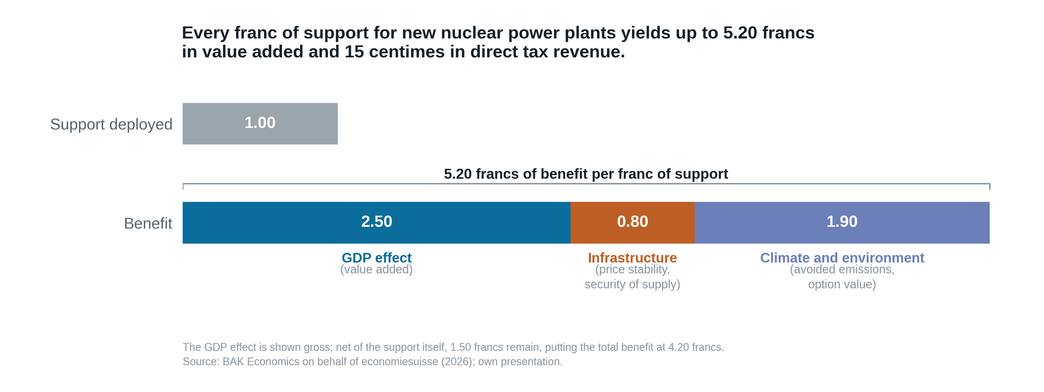
Nowadays, hardly any major infrastructure project is built without government support. That is true of nuclear power plants as well. This is precisely why the scale of the necessary support matters, as does what each franc of support actually achieves. According to the BAK Economics study cited above, every franc of public support yields 2.50 francs of gross value added along with 15 centimes in direct tax revenue; net of the support component itself, a net GDP effect of 1.50 francs remains. Factor in further effects – 0.80 francs for dampened seasonal price peaks and reduced shortage risk, 1.90 francs for climate and environmental benefits – and the benefit rises to 5.20 francs gross and 4.20 francs net per franc of support. Across its full 60-year operating life, the plant contributes 1.6 billion francs a year in value added and sustains around 2,900 jobs.2 (Comparable analyses for other energy systems are lacking. Structural factors such as the high import dependency for solar modules and components suggest, however, that domestic value added per franc is likely lower than for nuclear power plants.)
Nuclear energy is thus by no means a “money pit” without economic benefit. This becomes even clearer when one considers that the levelised cost of electricity (LCOE) discussed above is not the same as the system costs of a stable electricity supply: here, costs for grid expansion, storage and backup must be factored in, and higher price volatility – for instance from greater import dependency – also carries economic costs. The Axpo study already mentioned therefore concludes that the lowest costs are achieved in the “coexistence” scenario – that is, a combination of renewables, nuclear power and gas. Accordingly, lifting the ban on construction and immediately beginning preparations for new nuclear power plants is part of the study’s policy recommendations.6
Sources (5)
- [1] Alliance “Nein zu neuen AKW,” “New nuclear power plants are extremely expensive and lead to higher electricity prices”: https://www.neue-akw-nein.ch/argumente/kosten ↩
- [2] BAK Economics / economiesuisse, “Economic Effects of Replacing Switzerland’s Nuclear Power Plants” (July 2026): https://backend.economiesuisse.ch/sites/default/files/2026-07/BAK_Economics_ecnoomiesuisse_Impact-Analyse_KKW-Ersatzneubau.pdf ↩
- [3] stromzeit.ch, “Solarexpress: Current status of alpine solar expansion”: https://www.stromzeit.ch/blog/strom-7/solarexpress-aktueller-stand-beim-ausbau-der-alpinensolaranlagen-schweiz-forderziele-deutlich-verfehlt-679 ↩
- [4] Swiss Federal Office of Energy (BFE), “One-off payment for large-scale PV installations”: https://www.bfe.admin.ch/de/pv-grossanlagen-eiv ↩
- [5] Axpo, “Axpo Energy Reports – Synthesis” (March 24, 2026): https://www.axpo.com/content/dam/axpo19/ch/energyreports/reports/en/Axpo_Energy_Reports_Synthese_EN.pdf ↩
“Nuclear Energy Is Too Dangerous”
The opposing campaign claims“A major accident like Chernobyl in 1986 or Fukushima in 2011 would threaten Switzerland's very existence.” (Alliance “Nein zu neuen AKW,” “Key Arguments,” “Risks”)1
No technology is without risk or other drawbacks. This is undeniably true of nuclear power as well – the question is how high this risk actually is for modern reactors, and whether comparison with Chernobyl and Fukushima is an appropriate benchmark: both meltdowns were shaped by design- and site-specific weaknesses that do not apply to today’s Swiss reactors. The Chernobyl reactor was a graphite-moderated RBMK type without a Western-style containment building – a design that was never licenced in Switzerland and is no longer built anywhere today. Fukushima was primarily the result of a severe earthquake and subsequent tsunami – a scenario that cannot geologically occur at an inland Swiss site – combined with a failure to comply with safety regulations on the part of the Japanese operator TEPCO.
A study commissioned by economiesuisse in March 2026 quantifies, for the first time, the risk of severe accidents at new Generation 3+ reactors: the probability of a severe accident with radioactive release is around 100 times lower than for the reactors running in Switzerland today and for many years now. Even accounting for all retrofits to the existing fleet, it is still around 10 times lower. The resulting theoretical insurance risk costs come to CHF 0.000009–0.00009 per kilowatt-hour – an order of magnitude that, according to the study, shows no measurable difference from renewables.2
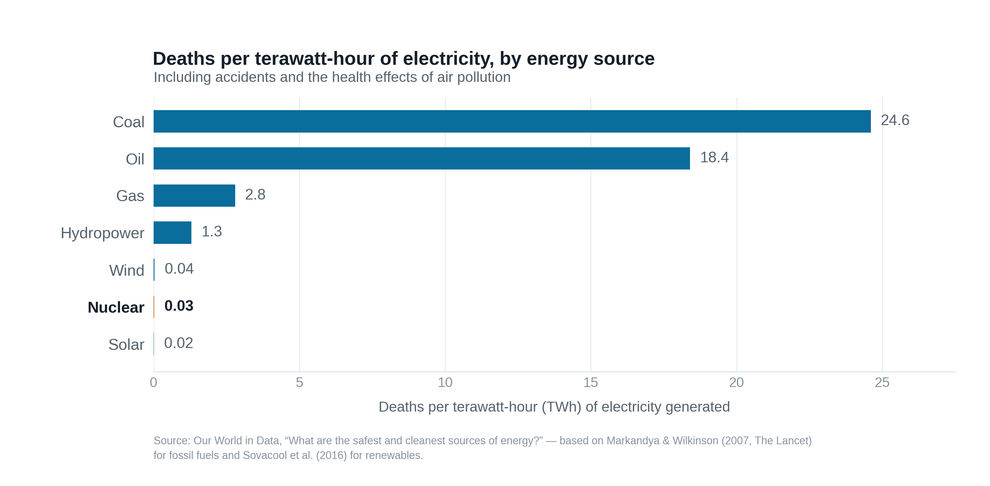
In any case, statements about the danger of individual technologies only make sense in comparison across all energy sources – including the consequences of normal operation, above all air pollution, which is regularly overlooked in public debate. A widely cited analysis by Our World in Data, which accounts for both accidents and the health effects of air pollutants, puts the death rate per terawatt-hour of electricity generated from nuclear power at 0.03 – comparable to solar and wind energy. Coal, by contrast, kills 24.6 people per terawatt-hour – nuclear power thus causes around 820 times fewer deaths per TWh than coal and is not worse than solar or wind.3
A recent analysis by WePlanet and the Anthropocene Institute on Germany’s nuclear phase-out arrives at an almost identical result: because the shut-down nuclear capacity was largely replaced by coal- and gas-fired power, the resulting additional air pollution in Germany is estimated to have caused over 24,600 premature deaths by March 2026 – more than six times as many as even the most pessimistic estimates for the total number of Chernobyl deaths (around 4,000, according to the WHO), and around 400 times as many as the immediately documented Chernobyl deaths (60).4 Retreating from nuclear power “in the name of safety” has, in this case, exposed the population to a significantly greater – merely less visible – risk.
A 2015 Federal Council report cites estimates of the potential damage from a severe nuclear accident in Switzerland ranging between 88 billion (1995 EU Commission study) and 8,000 billion francs (2003 BABS estimate)5 – the range reflects not so much genuine uncertainty rather than the fact that two methodologically very different decades-old studies (dating back to the 1990s) were used here. A sensible benchmark for comparison is the risk acceptance for other energy infrastructure: hydropower, too, is not risk-free. The Vajont dam disaster (Italy, 1963) officially claimed 1,917 lives, with other estimates putting the toll well above 2,000.7 Switzerland today operates around 200 large dams under federal supervision, without this being considered socially unacceptable – and this despite the dams growing ever older, with thawing permafrost due to climate change increasing the risk of landslides into reservoirs, which in turn raises the risk of a major accident.
It is occasionally also claimed that, in times of rising global tensions, nuclear power plants would represent a particular risk as a possible target of hostile attacks (as argued, for instance, by SP National Councillor Jon Pult in a piece for “Südostschweiz”8). It’s true: no nuclear power plant is designed to withstand a deliberate military attack – but the same is true of practically every major energy and water infrastructure facility. Once again, dams represent the far greater and more obvious risk: in the Second World War, Britain’s Royal Air Force deliberately destroyed the Möhne and Eder dams (May 1943); the resulting flood wave killed between 1,300 and over 2,400 people, most of them forced labourers.9 In June 2023, during the war in Ukraine, the Kakhovka Dam was destroyed – with at least 62 confirmed deaths, up to 60,000 people placed in immediate danger, and far-reaching ecological consequences.10 These two examples show that the risk of military destruction of critical infrastructure is real, but not a nuclear-specific problem – historically, it demonstrably hits large-scale hydropower infrastructure harder and more often, without this being used as an argument for abandoning hydropower.
Sources (10)
- [1] Alliance “Nein zu neuen AKW,” “Nuclear power is risky”: https://www.neue-akw-nein.ch/argumente/risiken ↩
- [2] economiesuisse, “Study shows for the first time: new generations of nuclear power plants bring massive safety gains” (March 11, 2026): https://www.economiesuisse.ch/de/artikel/studie-zeigt-erstmals-zahlenneue-generationen-von-kernkraftwerken-bringen-massive ↩
- [3] Our World in Data, “What are the safest and cleanest sources of energy?” (data table “Death rates from energy production per TWh”): https://ourworldindata.org/safest-sources-of-energy ↩
- [4] WePlanet / Anthropocene Institute, “Germany’s Nuclear Phase-Out – The True Costs for People, Climate, and the Economy” (March 2026): https://www.weplanet.org/_files/ugd/dccfdc_892b580b526749819b933ff6fb8500fc.pdf ↩
- [5] Federal Council, “State Liability Risk Regarding Nuclear Power Plants” (report in fulfilment of Postulate 11.3356, January 21, 2015), p. 10: https://www.newsd.admin.ch/newsd/message/attachments/38020.pdf ↩
- [6] Wikipedia, “Reactor Lucens”: https://en.wikipedia.org/wiki/Lucens_reactor ↩
- [7] Wikipedia, “Vajont Dam”: https://de.wikipedia.org/wiki/Vajont-Staumauer ↩
- [8] Jon Pult, “New Nuclear Plants? No Thanks,” “Berner Politik” column, Südostschweiz, July 14, 2026: https://www.suedostschweiz.ch/graubuenden/neue-akw-nein-danke-2043706 ↩
- [9] Wikipedia, “Operation Chastise”: https://de.wikipedia.org/wiki/Operation_Chastise ↩
- [10] Wikipedia, “Destruction of the Kakhovka Dam”: https://de.wikipedia.org/wiki/Zerstörung_des_Kachowka-Staudamms ↩
“Switzerland Can Reach Net-Zero by 2050 Just as Easily Without Nuclear Energy”
The opposing campaign claims“Switzerland will be able to cover its electricity demand with renewables.” (Alliance “Nein zu neuen AKW,” press release on the National Council decision)1
The claim rests on a study by the Swiss Energy Foundation from November 2025, which goes further still: lifting the construction ban alone would, on its account, slow the renewables buildout and thereby endanger the climate targets.2 Independently of that, the proposition that Switzerland could cover its future electricity demand without nuclear energy finds support in a study published in June 2026 by ETH Zurich and the Paul Scherrer Institute.3
Unlike Claim 3, what is at stake here is not today’s balance sheet but a model for 2050, and a model delivers the result its assumptions permit. The findings therefore need context, because “technically feasible” is not the same as “free of conflicting goals”. First, the same study shows that without nuclear power Switzerland would still have to import between 5.4 and 12.4 TWh of electricity in the winter half-year of 2050, much as it does today. For comparison: between October 2025 and March 2026 the figure was around 7 TWh, with only a single nuclear plant under maintenance.3 This only counts as “net-zero” if the imported electricity is both available and clean. Switzerland controls neither condition; both depend on developments in the rest of Europe. The bottleneck lies in winter security of supply, and forgoing new nuclear plants does not dissolve it.
Second, the ETH/PSI study leaves out an important uncertainty in its scenario. The direct alternative to dispatchable nuclear power is storage hydropower, which is likewise dispatchable and could therefore play a comparable role in the energy mix, unlike solar or wind power and complementary to them. Climate change, however, is putting the reliability of hydropower on shaky ground. In summer 2026, Swiss reservoirs fell to around 46 percent capacity after the driest spring since records began in 1864, the lowest level in 20 years.4 The outlook beyond that is uncertain too. Glacier retreat and higher precipitation will, according to Axpo, let winter generation rise slightly at first until mid-century.5 In the long term, the infrastructure is also under pressure: the Federal Office for the Environment anticipates that glacier retreat, thawing permafrost and more frequent heavy rainfall will exacerbate the natural hazards facing Alpine hydroelectric power plants and cause reservoirs to silt up more quickly due to sediment deposition.6
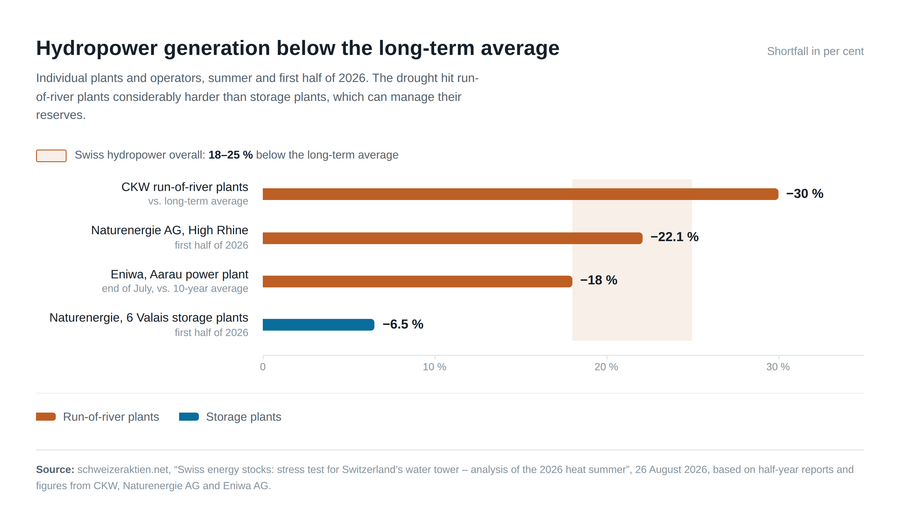
A net-zero strategy built centrally on dispatchable hydropower thus relies on precisely the source whose reliability climate change itself is eroding, a risk that does not arise in the first place with a weather-independent technology such as nuclear power. The summer of 2026 demonstrated the point: the Swiss Federal Institute WSL assessed the drought as exceptional, the alpine reservoirs filled far more slowly than usual, and low water levels meant many run-ofriver plants could only generate at reduced output.7 What drew public attention instead was that two units of the Beznau nuclear plant had to be shut down temporarily because the cooling water was too warm8, a design problem solvable by retrofitting or in a new build: the Gösgen plant has used a natural-draught cooling tower rather than river water since 1970 and was spared any curtailment.9 That output reductions at nuclear plants attracted so much attention while the problems facing hydropower drew almost none shifts the view of where the real supply risks lie.
“Technically feasible” is not the same as “cheaper” either, and here too the study quoted above repays a closer look. By its account, new nuclear plants only become competitive at construction costs of at most around CHF 8,000 per kilowatt. At CHF 5,000 per kilowatt, by contrast, 2.6 to 4.9 gigawatts of new capacity would make economic sense.3 The study assumes CHF 12,000, a figure probably shaped in large part by the French Flamanville 3 project. Take the Finnish reactor Olkiluoto 3 as the reference instead, as the BAK Economics study already cited in Claim 5 does, and a considerably more favourable picture emerges. Total project costs of around EUR 11 billion for a capacity of 1,600 megawatts work out at roughly CHF 6,500 per kilowatt10, below the CHF 8,000 threshold at which the ETH/PSI study considers new nuclear plants competitive. Whether a replacement build under Swiss regulation, approval procedures and wage levels could actually be realised at costs comparable to Finland’s is unclear. Then again, Olkiluoto 3 was the first reactor of its series and carried high first-of-a-kind costs as well as a 14-year construction delay; later projects in the same reactor family should come out cheaper.
Net zero by 2050 without new nuclear plants may look technically possible in the models. Whether the goal can also be reached in practice, and at what cost, is another matter entirely. Switzerland’s import dependence on its European neighbours would stay roughly where it is today, climate change casts doubt on the reliability of hydropower for baseload and balancing power, and the further development of costs remains unclear. Conflicting goals and risks cannot be dissolved by ruling out nuclear energy. They merely shift from known risks, the construction and financing costs of new nuclear plants, to several others that are harder to survey.
Taken together, that is a high degree of uncertainty. A sound rule of thumb for decision-making under high uncertainty is to choose robust paths, ones that hold up across as many conceivable circumstances as possible. Above all that means keeping as many options open as possible. Nuclear energy among them.11
Sources (11)
- [1] “No to New Nuclear Power Plants,” press release on the National Council decision: https://www.neue-akw-nein.ch/aktuelles/nationalrat-oeffnet-das-tor-fuer-neue-akwstimmbevoelkerung-wird-fehlentscheid-korrigieren ↩
- [2] Epprecht, N. / Hälg, L., “Politikfolgenabschätzung zur Aufhebung des AKW-Neubauverbots: Szenarien + Auswirkungen bei Zulassung neuer AKW,” Swiss Energy Foundation (SES), November 14, 2025: https://energiestiftung.ch/files/energiestiftung/Studien/2025_Politikfolgenabschaetzung/20251117_SES_St udie_Politikfolgenabschaetzung_publ.pdf ↩
- [3] ETH Zurich / PSI, “When new nuclear power plants are worth it in Switzerland” (June 29, 2026): https://ethz.ch/en/news-and-events/eth-news/news/2026/06/when-new-nuclear-power-plants-areworth-it-in-switzerland.html ↩
- [4] 20 Minuten, “Reservoirs at record lows: Why Switzerland’s electricity supply is still secure” (July 2026): https://www.20min.ch/story/tiefe-pegelstaende-was-passiert-wenn-die-schweizer-stauseenaustrocknen-103604832 ↩
- [5] Axpo, “Higher electricity production in winter”: https://www.axpo.com/ch/de/ueberuns/magazin.detail.html/magazin/erneuerbare-energien/Hoehere-Stromproduktion-im-Winter.html ↩
- [6] BAFU (Hrsg.) 2021: Auswirkungen des Klimawandels auf die Schweizer Gewässer, Umwelt-Wissen Nr. 2101, Kap. 7.1.3.: https://www.bafu.admin.ch/dam/de/sd-web/cPLO37edEVrg/auswirkungen-desklimawandels-auf-die-schweizer-gewaesser.pdf ↩
- [7] WSL (Swiss Federal Institute for Forest, Snow and Landscape Research), “Drought 2026: Frequently Asked Questions and Answers”: https://www.wsl.ch/de/metanavigation/im-fokus/trockenheit-2026-haeufige-fragen-und-antworten/ ↩
- [8] Blick, “Because the Aare is too hot: Beznau nuclear power plant shuts down both units”: https://www.blick.ch/schweiz/mittelland/aargau/weil-aare-zu-heiss-ist-kernkraftwerk-beznau-faehrtbeide-bloecke-herunter-id22150131.html ↩
- [9] NZZ, “Kernkraftwerke mit Kühltürmen bestehen auch bei Hitze und Trockenheit” (opinion piece): https://www.nzz.ch/meinung/kernkraftwerke-mit-kuehltuermen-bestehen-auch-bei-hitze-undtrockenheit-ld.10018893 ↩
- [10] Own calculation based on: POWER Magazine, “Olkiluoto 3 Finally Online in Finland” (2023): https://www.powermag.com/olkiluoto-3-finally-online-in-finland-germany-closes-last-three-nuclearplants/; World Nuclear Association, Reactor Database “Olkiluoto-3” (capacity 1,600 MW): https://worldnuclear.org/nuclear-reactor-database/details/olkiluoto-3 ↩
- [11] RAND Corporation, “Robust Decision Making”: https://www.rand.org/pubs/tools/TL320/tool/robustdecision-making.html ↩
Consequences of a Switzerland without nuclear power
The debate about new nuclear plants is usually framed as a yes-or-no question. Does Switzerland need nuclear power, or can it manage without? Opponents of new construction regularly argue that the loss of an existing plant could be absorbed inside Switzerland without much difficulty, by hydropower for instance, and that the consequences would stay largely domestic. To test this, the Anthropocene Institute analysed data from Swissgrid and Energy- Charts. The findings show why building new nuclear power plants makes sense from both a security-policy and an energy-economics perspective, and what the consequences would conversely be for a Switzerland without sufficient nuclear power, should new capacity not be built in time: more imports, tighter coupling to the European electricity system, and a markedly deeper dependence on generation abroad.
The analysis that follows combines two approaches. The first is an hour-by-hour analysis of how nuclear availability relates to cross-border power flows between 2021 and 2025. The second uses two outage episodes as test cases, the scheduled overhauls at Leibstadt in 2021 and at Gösgen in 2025. What do they reveal about the use of hydropower, about displacement of and dependence on foreign generation, about CO₂ emissions, and about how German electricity prices feed through to Switzerland?
Finding 1: the cross-border balance responds almost one for one
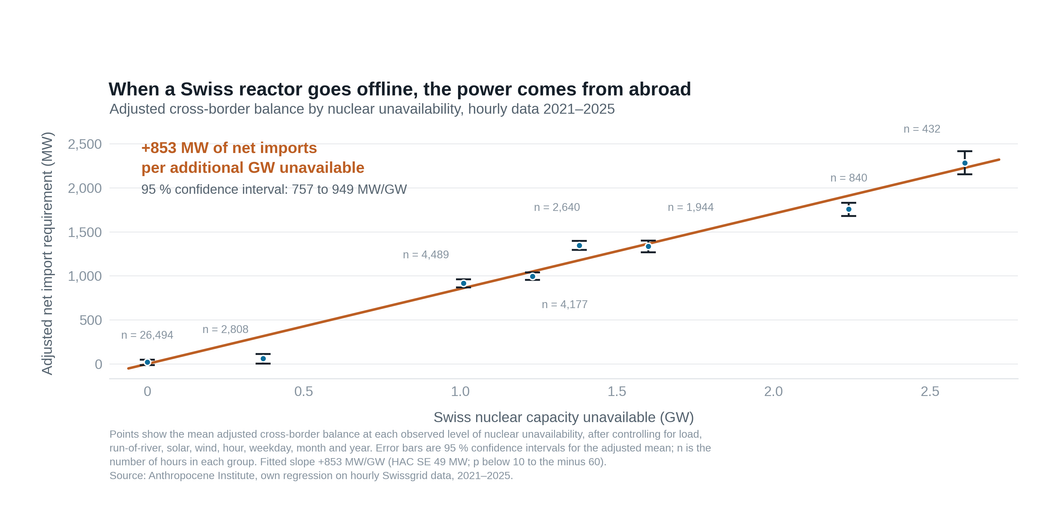
When 1 GW of Swiss nuclear capacity goes offline, Switzerland’s cross-border trade balance shifts by roughly 853 MW on average, either as additional imports or as reduced exports. The figure comes from a direct regression on observed hourly data across the full 2021–2025 period, controlling for load, run-of-river, solar, wind, hour, weekday, month and year, and the relationship is statistically unambiguous (95% confidence interval 757–949 MW/GW; p < 10⁻⁶⁰). Almost the entire shortfall from a Swiss outage is therefore balanced across the border rather than at home.1
Finding 2: hydropower is no direct substitute for nuclear, it gets shifted in time rather than added
Examining the two multi-month outages shows that when nuclear capacity is lost, Swiss reservoir hydropower is primarily shifted in time. During each outage period, roughly 2.13–2.16 TWh of hydropower generation was initially “brought forward” – yet almost the entire quantity was “paid back” out of normal operation in the following months (2.126 and 2.158 TWh respectively). Across the full observation period, only a minimal residual difference (0.005 and 0.001 TWh) was genuinely balanced by hydropower.2
This is the finding that carries the most weight for the new-build debate, because it is not confined to these two episodes, but a structural feature. Hydropower and nuclear complement each other instead of competing. Reservoirs are an instrument of flexibility with a fixed volume, not extra capacity conjured out of nowhere. Put in economic terms, a reservoir carries intertemporal opportunity costs: water used now is water unavailable later. The same logic extends beyond the two outages studied here to any lasting decline in firm, weatherindependent capacity, including a scenario in which no replacement NPPs are built and nuclear capacity shrinks.
The clear conclusion: hydropower and nuclear cannot fully substitute for one another. When nuclear is available, Switzerland can save its reservoir water for the most valuable hours; when it is absent, that headroom is used to close a gap in the short term – but not to replace nuclear permanently.
In total, balancing the two outages examined here required around 4.79 TWh (Leibstadt 2021) and 4.58 TWh (Gösgen 2025) of additional generation in neighbouring countries – spread across Germany, France, Italy and Austria.3
Uncertain findings: CO₂ effect and the “German factor”
Two further questions can only be answered provisionally with the data at hand.
Using a country- and technology-specific displacement model, we estimate the additional CO₂ emissions during the nuclear outages at roughly 2.2 Mt (Leibstadt 2021) and 1.8 Mt (Gösgen 2025) – predominantly from additional gas generation, with a larger share of coal and lignite in 2021.
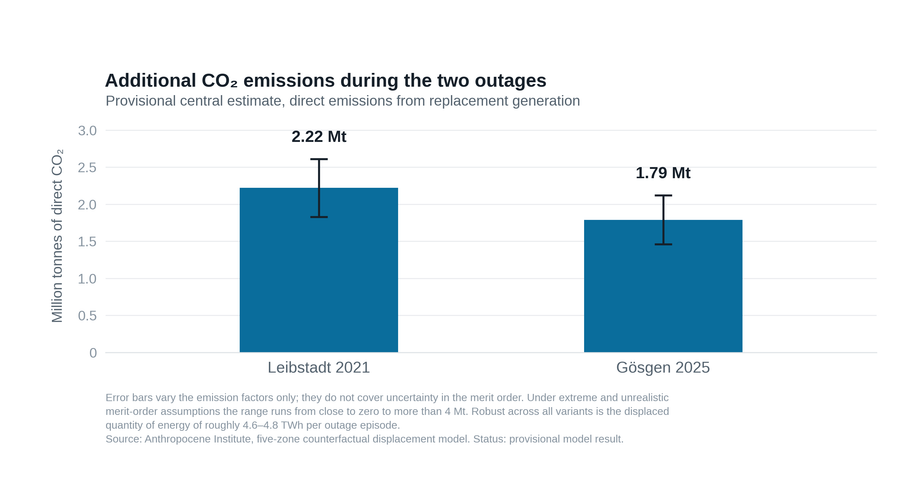
This figure is model-dependent, however: under extreme and unrealistic assumptions about merit order, the range runs from close to zero to more than 4 Mt.4 There is a further caveat. The question that matters concerns the consequences of a replacement that never gets built, which means conditions in the 2040s and beyond. What electricity mix will then be available for import is barely possible to estimate today. What is robust, therefore, is above all the displaced quantity of energy (around 4.6–4.8 TWh per outage episode); while the precise fuel composition, and with it the consequences for the climate and for climate targets, remains an estimate.
A further analysis uses the same two episodes to ask whether the Swiss price premium during an outage depends on how much nuclear Germany is generating at the same time (six reactors in 2021, none left by 2025). Across the two German regimes the relationship is statistically significant: more German nuclear goes with a smaller Swiss premium.5 Conversely: the now permanent absence of German nuclear power is pushing up the cost of imported electricity for Switzerland. Even though no comparable analysis is yet possible for the coming coal phase-out, it is at least reasonable to suspect that this effect – missing generating capacity abroad driving up import costs – will grow stronger rather than weaker.
What this means for the new-build question
This analysis is meant less as a historical account than as a thought experiment. What would a Switzerland without new nuclear mean for security of supply, for dependence, and for emissions? The two outage episodes show it in miniature. Two of the findings carry over to the future reliably, because they rest on basic physical and economic mechanisms.
- A Swiss nuclear plant is not an isolated national asset but a building block in the European grid. When its output is missing, the bulk of the replacement arrives across the border, not from a domestic fix. That applies to any capacity loss of this order, not only to the two overhauls examined here. Storage hydropower shifts energy in time within a fixed volume. It is no durable, dependable substitute for firm, weather-independent capacity. Anyone who forgoes new construction while quietly counting on hydropower to fill the gap overestimates what it can do: as the analysis shows, the reservoirs are already almost fully committed to ordinary fine-tuning of the system.
Conversely, the same calculation shows just how small the remaining portion to be replaced is. In 2025, approximately 3.6 TWh of Switzerland’s electricity generation came from thermal power plants – including not only fossil-fuel plants but also waste-to-energy facilities, wood and biogas. A single reactor with a capacity of 1.2 gigawatts and 90 percent availability generates about 9.5 TWh per year – more than two and a half times that amount. Even in a deliberately rigorous stress test – in which all thermal generation is allocated to the four hours of each day with the highest demand – such an additional reactor, together with existing hydropower, would be sufficient to cover those hours. This works precisely because of hydropower: if nuclear power operates around the clock, less reservoir water needs to be turbined during off-peak hours, leaving it available for peak hours. The remaining surplus would reduce imports or increase exports – and could thus also help neighbouring countries phase out their own fossil fuel-based generation.6
In both episodes the generation displaced abroad was predominantly fossil. That points to a lasting reduction in Swiss nuclear capacity going hand in hand with more fossil generation next door, even though the exact CO₂ balance depends on the model and cannot be pinned down conclusively. Less solid, but notable in economic and security terms alike, is the finding on the interplay with German nuclear. It suggests that the European nuclear fleet may have damped price spikes during Swiss outages. Should firm generating capacity keep declining in several of Switzerland’s neighbours, the same mechanism would push prices higher still.
This analysis shows not only what two specific outages cost – it shows what an electricity system with structurally less Swiss nuclear power would look like. Increased import dependence, an overestimated buffering role for hydropower, and probably greater fossil generation in the neighbourhood are not hypothetical risks but observed responses of the system. Replacement build can help to solve these problems, or at least to alleviate them. Those who reject new nuclear power plants must explain how they intend to avoid these consequences.
Sources (6)
- [1] Own regression analysis on hourly data for the full 2021–2025 period (Swissgrid cross-border flows, controlled for load, run-of-river, solar, wind, hour, weekday, month, year). ↩
- [2] Own storage-hydropower retiming model (v2) for the two outage episodes Leibstadt 2021 and Gösgen 2025, checked against observed price and dispatch patterns and SFOE reservoir data. ↩
- [3] Own five-zone displacement model for the same two outage episodes, based on Energy-Charts generation data (DE/FR/AT/IT) and Swissgrid cross-border flows. ↩
- [4] Own five-zone dispatch model for the same two outage episodes; sensitivity band from extreme (unrealistic) merit orders. ↩
- [5] Own regression analysis for the same two outage episodes: Swiss price premium relative to DE/FR/AT as a function of German nuclear generation, with and without regime centring. ↩
- [6] Own calculation based on the Swiss Electricity Statistics 2025 (thermal generation) and a dispatch stress test in which the total thermal generation is allocated to the four hours of the day with the highest demand; assumed reactor capacity of 1.2 GW with 90 per cent availability. ↩
Conclusion
Seven claims, one recurring pattern: the opposition campaign rarely works with false figures, but regularly with incomplete ones. Three popular votes are folded into a single verdict against nuclear energy, though only one of them touched the question at all. Russian dependence is asserted for uranium mining, where it is minor, rather than for enrichment, where it was real and is now being dismantled. Nuclear waste counts as an unsolved problem while the siting procedure has been concluded. And the “Swiss way” is called a success that the electricity industry’s own scenarios do not support. Anyone who knows the complete figures reaches different conclusions than the No campaign suggests.
This report, too, has looked at the merits of nuclear energy only partially, namely as a source of electricity. Yet what reactors generate first is heat, and heat can also be used directly. Beznau has been demonstrating this in Switzerland for decades: through the Regionale Fernwärme Unteres Aaretal district heating network, the plant supplies surrounding municipalities with around 170 GWh of heat a year from part of its waste heat, displacing heating oil that would otherwise be burned.1 What is to replace that heat remains open to this day. The plan is a wood-fired plant in Döttingen, whose fuel requirement was initially put at roughly 59,000 tonnes of wood chips a year; Refuna is now additionally examining a large-scale heat pump drawing on water from the Aare.2 Whichever option or combination is eventually built, all it does is replace a source of heat that already exists. For meeting the climate targets, heat may well matter more than electricity itself, because space heating and process heat are among the hardest sectors to decarbonise. Many new reactor designs reflect this, small modular reactors (SMRs) in particular, which are built with applications beyond electricity generation in mind. That is a further advantage of the flexibility nuclear energy brings, and one this report, focused as it is on replacement build for the existing reactors, could not do justice to.
Nuclear energy is not the cheapest way to produce a kilowatt-hour, yet most analyses point to the lowest total system costs arising where renewables and nuclear power coexist. A replacement build will not come about without state participation, but that is hardly unique to nuclear energy: scarcely any large infrastructure project today manages without public funds, and measured per subsidised kilowatt-hour, nuclear power does not exceed the support given to alpine solar. What matters is what the money achieves. According to the BAK study, every franc of funding generates an economic benefit of up to 5.20 francs, primarily within Switzerland, because construction, operation and maintenance take place here. To that comes what is harder to quantify: a country covering a growing share of its winter electricity through imports gives up control over prices, over availability and over its own bargaining position. And shutting down a practically carbon-free source of baseload power shifts emissions to the neighbourhood, as the analysis of the two outage episodes shows.
In the end, one question remains that no study can answer. Nobody knows what electricity will cost in 2050, which mix will then be available for import, how reliably hydropower will produce in a warmer climate, or how quickly the renewables build-out will advance. Under uncertainty of that kind, what counts is not which path looks cheapest in the model, but which holds up across as many conceivable developments as possible. Decision research calls this robust planning, and its central advice is to keep options open rather than committing narrowly too early.3
That is precisely what is at stake at the ballot box. A YES to the nuclear law builds no nuclear power plant. It merely opens the possibility of building one, should that prove sensible. A no closes off that option for another generation. Those who want this bear the burden of justification and must explain how a Switzerland without nuclear power will secure its winter supply, limit its import dependence and meet its climate targets in future. That explanation is one the opposing campaign has so far failed to provide.
Sources (3)
- [1] REFUNA AG, Regionale Fernwärme Unteres Aaretal: https://www.refuna.ch/ ↩
- [2] REFUNA AG / Axpo, project “Refuna Zukunft” (formerly Holzheizwerk Döttingen), technology review of February 18, 2026: https://refuna-zukunft.ch/2026/02/technologiepruefung-sorgt-fuer-mediale-resonanz/; additionally Aargauer Zeitung, “Baut die Refuna doch kein Holzheizwerk für die Wärmeversorgung nach AKW-Ende?”: https://www.aargauerzeitung.ch/aargau/zurzibiet/refuna-kein-holzheizwerk-fuerwaermeversorgung-nach-akw-ende-ld.4123494 ↩
- [3] RAND Corporation, “Robust Decision Making”: https://www.rand.org/pubs/tools/TL320/tool/robust-decision-making.html ↩

